A Year After the Letter: Girls in STEM Club Opens at Dr. Kadi A. Sesay Girls Secondary School
By Ibrahim Denis Fofanah
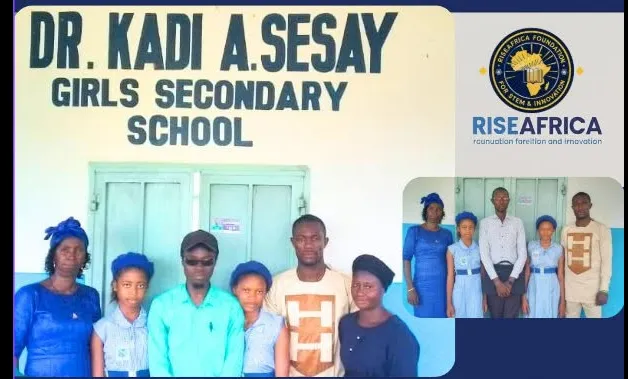
In July 2025, we walked up to the gate of Dr. Kadi A. Sesay Girls Secondary School in Port Loko and delivered a letter. It proposed a STEM club pilot: a space where girls at the school could learn practical science and technology skills, work on real problems, and see a future for themselves in fields they are too often kept out of.
Then we waited.
A year later, the school called us back.
From a letter to a partnership
Two weeks ago, we sat down with the school's leadership to talk about what a real partnership could look like. That conversation has now become an agreement, and we are proud to announce that a Girls in STEM club has been officially established at Dr. Kadi A. Sesay Girls Secondary School under the RiseAfrica Foundation for STEM and Innovation.
This is not a letter of intent anymore. It is a club, in a school, with students who will start learning.
What happens now
Our team will be going into the school to teach. The club becomes a regular, hands-on space where students learn the practical skills our tracks are built around, from digital and data skills to the problem-solving habits that carry into any technical career. Members join the wider RiseAfrica community, which means access to our learning platform, mentorship, and the challenges our learners across Africa take part in.
Why Port Loko, and why girls
Talent is everywhere across Africa. Opportunity is not. That gap is widest for girls in under-resourced communities, where the ability is never in question but the door is often closed.
Dr. Kadi A. Sesay Girls Secondary School has been a champion for girls' education in Port Loko for years. Putting a STEM club inside a school that already believes in its students is the fastest way we know to turn ability into opportunity. This club is part of Girls in STEM Rising, our continent-wide initiative to put girls at the centre of STEM learning rather than at its edges.
Why we are building this club the way we are
Late last year, researchers ran a randomised trial in Port Loko, the same district as this school. Around 1,700 students across 12 government-supported schools used an AI tutor for part of their maths lessons over eight weeks.
The results were encouraging. Scores went up.
But the study found something else that shaped our thinking. The gains were not shared evenly. Students who started ahead improved the most, and the gap between them and the students who were struggling grew wider. The technology worked, but on its own it rewarded those who were already doing well.
We take that seriously, because the girls who most need this club are often the ones starting furthest behind. A club that simply hands out tools risks helping everyone except the students we exist to serve.
So we are building this one differently. Mentors sit at the centre, not at the edges. We will know where each girl is starting so no one quietly falls behind. We pair students deliberately when they share a device. And where the foundations are not yet in place, we build those first, because tools only help once there is something to build on.
Technology can open a door. People are what walk a student through it.
The study was run by Google's LearnLM team with Fab AI, in 12 government-supported schools in Port Loko District between October and December 2025, with independent assessment by Oxford MeasurEd.
What the club needs
We want to be honest about what it takes to run this well.
Our learning is hands-on and browser-based, built to work on modest devices and slow networks. But a club still needs the basics, and this is where partners and supporters make the difference:
- Devices. Laptops or tablets the girls can actually work on during sessions. Refurbished machines are welcome and go a long way.
- Connectivity. Data bundles so sessions are not cut short by an empty balance.
- Power. Reliable power or a solar backup, so a session does not end when the electricity does.
- Mentors. Technical mentors, in Sierra Leone or anywhere in the world, willing to give a few hours a month. Much of this can be done remotely.
- Learning materials. A projector, notebooks, and the everyday supplies that make a classroom work.
If you or your organisation can help with any of these, we would love to hear from you. A single laptop puts a girl in front of real work. A few mentor hours a month can change what she believes is possible.
Support this club or partner with us.
To the school
Thank you for the welcome, and for calling us back. To the students who are about to join: we cannot wait to meet you.
Let us raise a generation of empowered young women in Africa.
Interested in bringing a RiseAfrica club to your school? Get in touch.