Launching an open STEM dataset in Krio, Mende and Temne
By RiseAfrica Foundation
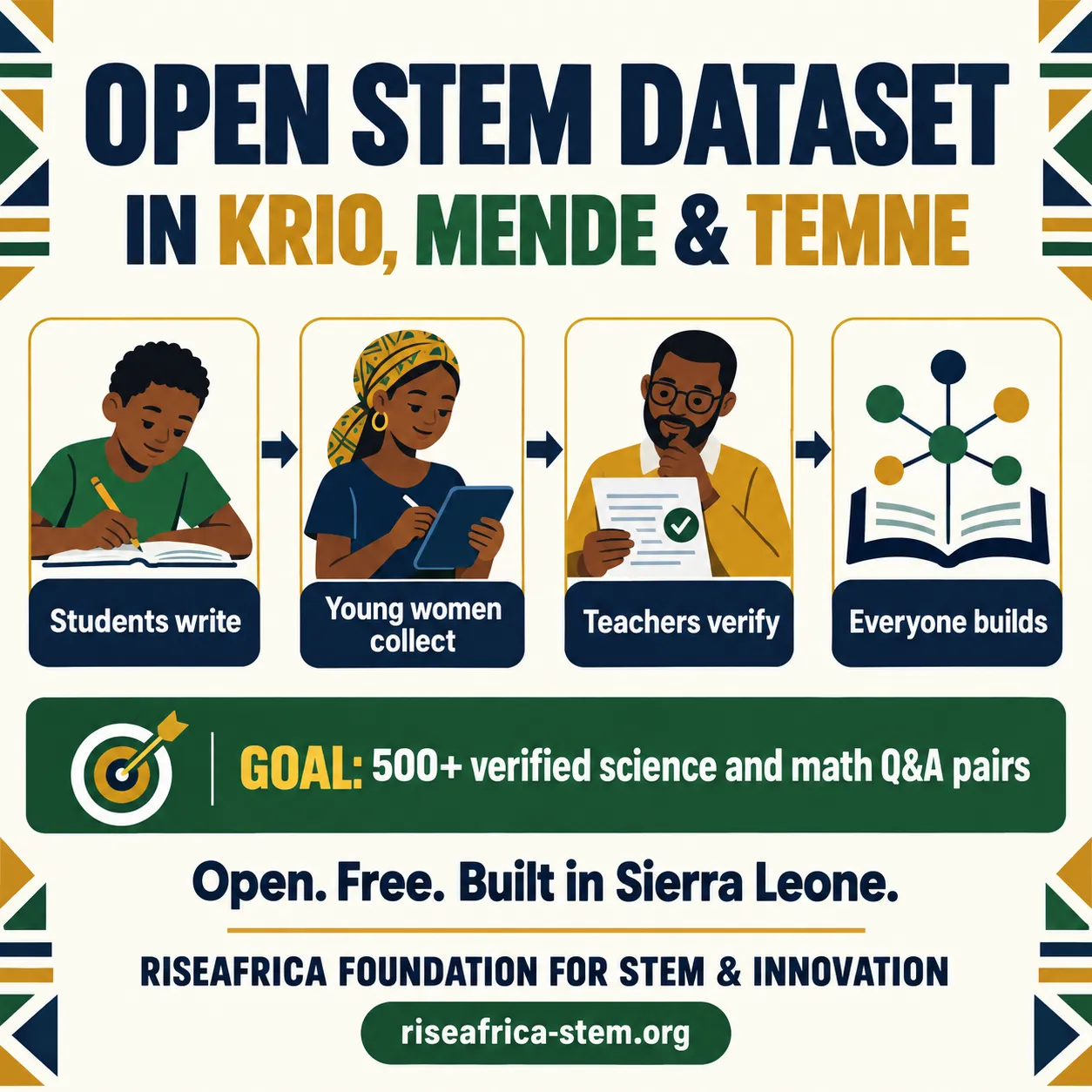
On 27 September 2026, our Sierra Leone national team kicked off a project we have been building toward for months: an open STEM learning dataset in Krio, Mende and Temne, the languages many of our students speak at home.
The goal is simple to say and hard to do: at least 500 science and math question-and-answer pairs, written by students, verified by teachers, in three languages, collected across the North, South and East of the country, and released open and free for anyone to build on.
Why this dataset needs to exist
Almost every learning tool a Sierra Leonean student touches speaks only English. The apps, the chatbots, the tutoring platforms were trained on data from somewhere else, in a language most of our students think in second.
But students learn best when ideas are explained in the language they think in. A child in Makeni who puzzles through a math problem in Krio is doing the same thinking as a child anywhere in the world. The only difference is that almost nobody has bothered to build learning technology that meets her where she is.
That is the gap SaloneLearn closes. An open, teacher-verified dataset gives educators, researchers, and developers in Sierra Leone something real to build on: real questions, in real home languages, checked by real teachers. It is the raw material for the Krio chatbot we are building, for tutoring tools, for exam prep, for anything a builder in Freetown or Bo or Kenema dreams up next.
And because it is open, it does not belong to us. It belongs to everyone.
How it works
1. Students write. Students across the three regions write STEM questions and answers in Krio, Mende, or Temne, the language they speak at home.
2. Young women collect. We trained young women as STEM data collectors alongside Girls Connect Sierra Leone. They gather the questionnaires from classrooms and enter every response, skilled work that puts them at the heart of the project.
3. Teachers verify. Every single question-and-answer pair is checked by a teacher before it goes into the dataset. If it is wrong, it does not ship. That verification is what makes the dataset trustworthy.
4. Everyone builds. Once the collection is complete, the full dataset goes public and free.
Where things stand
The questionnaires are already in classrooms. Students were filling them out within days of the launch, and our data collectors are gathering the first batches now. Teacher verification runs alongside collection, so the dataset grows in verified pairs, not raw ones.
Who is behind it
This is a Sierra Leone national team effort, our National Coordinator Ahmed Sunun Jeezuz Bah and National Programme Manager Mohamed Saidu Mansaray, delivered with Girls Connect Sierra Leone through the Salone Learn Pilot.
What comes next
Collection, verification, then the open release. After that, the dataset feeds directly into our Krio chatbot for students and farmers, and we will keep growing it term by term.
Are you a teacher who could review entries, or a developer or researcher who wants to use the data? Get in touch. This is the kind of project that gets better the more people touch it.